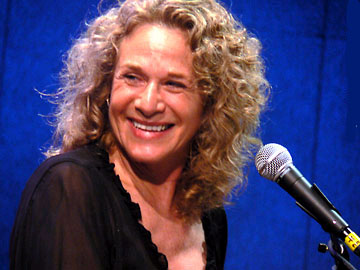
Carole King biography
While the landmark album Tapestry earned her superstar
status, singer/songwriter Carole King had already firmly established herself as
one of pop music's most gifted and successful composers, with work recorded by
everyone from the Beatles to Aretha Franklin. Born Carole Klein on February 9,
1942, in Brooklyn, New York, she began playing piano at the age of four, and
formed her first band, the vocal quartet the Co-Sines, while in high school. A
devotee of the composing team of Jerry Lieber and Mike Stoller (the duo behind
numerous hits for Elvis Presley, the Coasters, and Ben E. King), she became a
fixture at influential DJ Alan Freed's local Rock 'n' Roll shows; while
attending Queens College, she fell in with budding songwriters Paul Simon and
Neil Sedaka as well as Gerry Goffin, with whom she forged a writing
partnership.
In 1959, Sedaka scored a hit with "Oh! Carol," written in her
honor; King cut an answer record, "Oh! Neil," but it stiffed. She and
Goffin, who eventually married, began writing under publishers Don Kirshner and
Al Nevins in the famed pop songwriting house the Brill Building, where they
worked alongside the likes of Doc Pomus, Mort Shuman, Jeff Barry, Ellie
Greenwich, and countless others. In 1961, Goffin and King scored their first
hit with the Shirelles' chart-topping "Will You Love Me Tomorrow";
their next effort, Bobby Vee's "Take Good Care of My Baby," also hit
number one, as did "The Locomotion," recorded by their baby-sitter,
Little Eva. Together, the couple wrote over 100 chart hits in a vast range of
styles, including the Chiffons' "One Fine Day," the Monkees'
"Pleasant Valley Sunday," the Drifters' "Up on the Roof,"
the Cookies' "Chains" (later covered by the Beatles), Aretha
Franklin's "(You Make Me Feel) Like a Natural Woman," and the
Crystals' controversial "He Hit Me (And It Felt Like
a Kiss)."
King also continued her attempts to mount a solo career, but scored only
one hit, 1962's "It Might as Well Rain Until September." In the
mid-'60s she, Goffin, and columnist Al Aronowitz founded their own short-lived
label, Tomorrow Records; Charles Larkey, the bassist for the Tomorrow group the
Myddle Class, eventually became King's second husband after her marriage to
Goffin dissolved. She and Larkey later moved to the West Coast, where in 1968
they founded the City, a trio rounded out by New York musician Danny Kortchmar.
The City recorded one LP, Now That Everything's Been Said, but did not tour due
to King's stage fright; as a result, the album was a commercial failure,
although it did feature songs later popularized by the Byrds ("Wasn't Born
to Follow"), Blood, Sweat & Tears ("Hi-De-Ho"), and James
Taylor ("You've Got a Friend").
Taylor and King ultimately became close friends, and he encouraged her
to pursue a solo career. 1970's Writer proved a false start, but in 1971, she
released Tapestry, which stayed on the charts for over six years and was the
best-selling album of the era. A quiet, reflective work which proved seminal in
the development of the singer/songwriter genre, Tapestry also scored a pair of
hit singles, "So Far Away" and the chart-topping "It's Too
Late," whose flip side, "I Feel the Earth Move," garnered major
airplay as well. 1971's Music also hit number one, and generated the hit
"Sweet Seasons"; 1972's Rhymes & Reasons reached number two on
the charts, and 1974's Wrap Around Joy, which featured
the hit "Jazzman," hit the number one spot.
In 1975, King and Goffin reunited to write Thoroughbred, which also
featured contributions from James Taylor, David Crosby, and Graham Nash. After
1977's Simple Things, she mounted a tour with the backing group Navarro and
married her frequent songwriting partner Rick Evers, who died a year later
after a heroin overdose. 1980's Pearls, a collection of performances of songs
written during her partnership with Goffin, was her last significant hit, and
King soon moved to a tiny mountain village in Idaho, where she became active in
the environmental movement. After 1983's Speeding Time, she took a six-year
hiatus from recording before releasing City Streets, which featured guest Eric
Clapton. In 2001, she returned with Love Makes the World, a self-released disc
on her own Rockingale label. Four years passed before her next record, The
Living Room Tour, a double disc set documenting her intimate 2004-05 tour that
found her revisting songs from throughout her career with only her piano and
acoustic guitars as accompaniment.