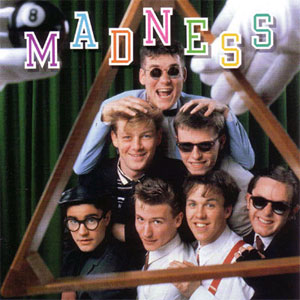
Madness biography
Along with the Specials, Madness were
one of the leading bands of the ska revival of the late '70s and early '80s. As
their career progressed, Madness branched away from their trademark "nutty
sound" and incorporated large elements of Motown, soul, and British pop. Although
the band managed one crossover American hit in 1983, the band remained a
British phenomenon, influencing several successive generations of musicians and
becoming one of the most beloved groups the country produced during the '80s.
The origins of Madness lie in a ska group known as the Invaders, which
was formed by Mike Barson, Chris Foreman, and Lee Thompson in 1976. By 1978,
the band had changed their name to Morris and the Minors and had added Graham
"Suggs" McPherson, Mark Bedford, Chas Smash, and Dan Woodgate to the
group. Later in 1978, they changed their name to Madness, in homage to one of
their favorite Prince Buster songs. The following year, Madness released their
debut single, a tribute to Prince Buster entitled "The Prince," on
Two-Tone. The song was a surprise success, reaching the British Top 20. Following
its success, the band signed a record contract with Stiff Records and released
another Prince Buster song, "One Step Beyond," which climbed to
number seven.
Madness quickly recorded their debut album, also titled One Step Beyond,
with producers Clive Langer and Alan Winstanley. Released toward the end of the
year, the album peaked at number two in Britain and it stayed on the charts for
well over a year. At the beginning of 1980, the band's third single, "My
Girl," peaked at number three. For the next three years, the group had a
virtually uninterrupted run of 13 Top Ten singles, during which time they were
one of the most popular bands in Britain, rivaled only by the Jam in terms of
widespread popularity. Where the Jam appealed to teenagers and young adults,
Madness had a broad fan base, reaching from children to the elderly. Which
didn't mean their music was diluted -- they continued to expand their sound,
both musically and lyrically.
In the spring of 1980, Madness released the Work Rest and Play EP, which
reached number six on the strength of the EP's lead song, "Night Boat to
Cairo." Also during the spring, One Step Beyond was released in the United
States, where it peaked at 128. Madness' second album, Absolutely,
was released in the fall of 1980. The record peaked at number two on the
British charts, but it stalled at number 146, in the U.S. Sire dropped the band
after the commercial disappointment of Absolutely,
leaving Madness without an American record contract for several years.
Back in England, Madness continued to gain momentum, as the group began
playing matinee shows on their tours so children under 16 years old could
attend the concert. In the fall of 1981, the band released their third album,
Seven, which peaked at number five. In January of 1982, Madness hit number four
with a cover of Labi Siffre's "It Must Be Love." In March, their
streak of Top Ten hits was interrupted when "Cardiac Arrest" stalled
at number 14 on the charts, due to radio's reluctance to play the tune. The
band bounced back a few months later with "House of Fun," their first
number one single. That same month, the hits compilation, Complete Madness,
reached number one.
Madness returned in the late summer of 1982 with The Rise and Fall, their full-fledged shift to pop. Like their previous
albums, it was a British hit, reaching the Top Ten, but it also contained the
seeds of their brief American success with the Top Five British single
"Our House." The single was released in America on the group's new
label, Geffen, and it received heavy airplay from MTV. The music-video
television network had previously played the videos for "House of
Fun," "It Must Be Love," and "Cardiac Arrest" when the
band's albums were unreleased in the United States, thereby setting the stage
for "Our House" to become a massive hit. With "Our House,"
Madness had MTV exposure coincide with a record release for the first time,
which sent the single into the American Top Ten in the summer of 1983. The
success of the single brought the U.S. compilation album, Madness, to number
41. Madness managed one more American Top 40 hit that fall, when "It Must
Be Love" peaked at number 33.
At the end of 1983, Mike Barson -- the band's key songwriter -- left the
group to settle down with his wife. Although Madness was able to stay near the
top of the charts with their first post-Barson release, "Michael
Caine," the band's fortunes began to decline over the course of 1984. Upon
its release in the spring, Keep Moving hit number six on the British charts; in
America, the record reached number 109. In June, the group released its final
single for Stiff Records, "One Better Day," which peaked at number
17. In the fall, Madness formed their own record
label, Zarjazz. Madness released "Yesterday's Men," their first
recording on Zarjazz, in September of 1985, nearly a year after the label's
formation. The record peaked at number 18 and its parent album, Mad Not Mad,
reached number 16 upon its October release. Their chart decline continued early
in 1986, when their cover of Scritti Politti's "Sweetest Girl" peaked
at number 35. For most of 1986, the group was quiet. In September, Madness
announced they were disbanding. Two months later, their farewell single,
"Waiting for the Ghost Train," was released, charting at number 18.
After staying dormant for a year and a half, the group reunited at the
beginning of 1988 as a quartet called the Madness, releasing its comeback
single, "I Pronounce You," in March. The Madness featured Chris
Foreman, Lee Thompson, Chas Smash, and Suggs, and was augmented by the
Specials' keyboardist Jerry Dammers and Steve Nieve (keyboards) and Bruce
Thomas (bass) of the Attractions. "I Pronounce You"
reached number 44 on the U.K. charts and its accompanying album stiffed upon
its spring release. The group disbanded for a second time that fall.
In the summer of 1992, the original lineup of Madness reunited to
perform two outdoor concerts at London's Finsbury Park. The group dubbed the
event Madstock and released a recording of the shows on Go! Records.
Madstock became an annual event for the next four years -- every summer the
band would reunite and headline an outdoor festival at Finsbury Park. Suggs
launched a solo career in 1995 with The Lone Ranger, which performed
respectably in the U.K. charts. In 1996, Madness played the final Madstock and
announced they planned not to reunite for future concerts, but by 1998 they
were back on the road, with a Los Angeles date recorded for release as
Universal Madness the following year. The group also reunited with original
producers Clive Langer and Alan Winstanley to record their first new material
in over a decade. The resulting Dangermen Sessions, Vol 1 was released in 2005.