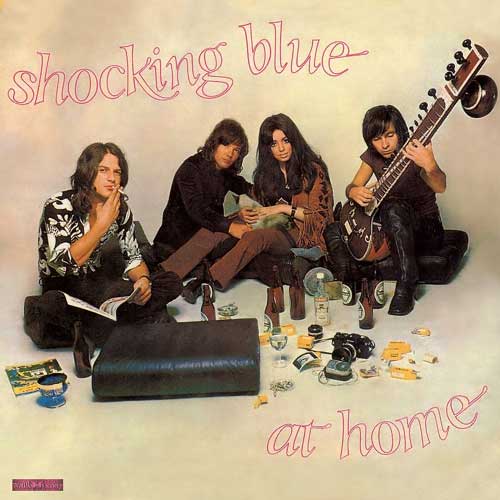
Shocking Blue biology
The Shocking Blue was formed in 1967 by guitarist Robbie van Leeuwen,
a veteran of a well known Dutch rock band, The Motions. The band's name was
inspired by an Eric Clapton track called "Electric Blue".
Joining Van Leeuwen in the group were drummer Cor van Beek, bass player Klaassje van der Wal and lead singer Fred de Wilde. In the spring of 1968,
Shocking Blue were signed to Dureco, an independent
company in the Netherlands.The group's first single,
"Lucy Brown Is Back In Town", was released on the company's Pink
Elephant label and went to number 21 on the Dutch top 40.
Shortly after this, Shocking Blue's manager and music publisher attended a
party celebrating the success of Golden Earring's first number one song in
"Venus" made Number 3 in
Shocking Blue's follow-up to "Venus", "Mighty Joe", made
Number 1 in
Shocking Blue successfully combined Beat and R&B with psychedelic elements
of the time like Indian sitar and odd production techniques. Robbie didn't mind
if the band included a few covers, as it took the pressure off him to
constantly come up with new material. "We wrote a lot of our own stuff and
the radio DJs preferred us to do original songs, but we had so many albums to
do the band had to fill in with a few covers. It was quite exhausting writing
all the lyrics and song myself".
For several months in 1970-1971 Leo van de Ketterij(guitar) played with
the group.
Mariska, Robbie, Cor and Klaasje stayed together for three years while they toured
the world, visiting such distant lands as
Although the band was still releasing excellent and often innovative singles
and still charting in
First Klasssje quit and was replaced with Henk Smitskamp in 1971.
Robbie van Leeuwen partially withdrew in 1973, his role was filled in by Martin van Wijk.
Shocking Blue carried on for a while without Robbie until Mariska
went off to launch a solo career in 1974.
Robbie surprised the Dutch music industry when he returned in the mid 70s with
Galaxy Lyn, a group much more folk and jazz oriented than Shocking Blue. He
also produced solo single "Too Young" for Mariska.
Then Robbie had some hits with a studio outfit called Mistral. This broke up in
the early Eighties, and in 1983 the guitarist moved from
One of my guests, Klaas, sent me the following
comments about Robbie van Leeuwen: "Next to
musically quite capable, Robbie was also a definite show monster, a jack in the
box who could easily beat somebody like Pete Townshend
on stage. Galaxy Lynn was unique for the world; they tried to bring modern
music based on electric mandolins (complete with all the effects) instead of
guitars. Also, their hairdos were very advance guard for that time. Mostly
bald, only on top a round patch that was still about a meter long with a knot
in it. Robbie was also very supportive to new talent. When I was singer in a
band in
In 1979 Robbie was planning to reunite the group, they even recorded a song
called "Louise" as part of Shocking Blue come back project. Unfortunately,
for some reason, the song was not realesed, and
project was cancelled.
At the end of 1984, Shocking Blue reunited for two concerts at a
"Back-to-the-Sixties" festival. It proved to be the nights to
remember: van Leeuwen still had style, and Mariska Veres still had one of
the greatest female rock voices. The band's interpretations of Jefferson
Airplane's "Somebody To Love" and "White Rabbit" were just
strong as their own songs.
According to the Dutch Shocking Blue page, in
September of 1993 Mariska Veres
breathed new life into Shocking Blue. But none of the former musicians
returned. Robbie van Leeuwen gave Mariska
the permission to use the name "Shocking Blue" for her group and
produced their CD-single "Body & Soul", released in 1994. The
group attends many sixties-and-seventies-festivals, especially in
Click here
to learn more about Shocking Blue of the 90s.
Here is what Gerrit Jan from
Holland, who witnessed Shocking Blue perform, emailed me:
"When I was young I never had the occasion to see Shocking Blue perform,
but I did see them in 1993 during a complete concert in Utrecht, where they
performed virtually all the single hits, plus work by Janis Joplin, in which Mariska sang very well! This last July
(1998) I saw them perform 30 minutes during the Utrecht Gay Saturday. It
was raining heavily that day, but the concert was great and the audience went
mad. They are still alive!"
Although labeled by many as
a one-hit wonder, due to the