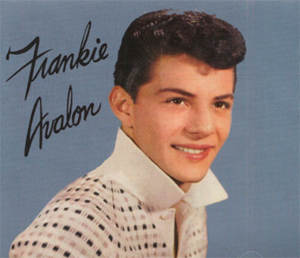
Discussing Frankie
Avalon's career as a mover and shaker in 1950s rock & roll with
anyone who takes their rock & roll even halfway seriously is to court
derision. Avalon was the first of the manufactured teen idols,
before Fabian and Bobby Rydell and
the myriad of other pretenders to the throne who worked the turf with tight
black pants and red, red sweaters to the fore while Elvis cooled
his heels in Germany. In the late '50s and early '60s, post-Twist and pre-Beatles,
these generally untalented pretty boys were the cardboard no-threat remnants of
a post-Elvis age. But Avalon had a real musical
background to go with the pretty boy looks, and was no drugstore teenager
waiting to be discovered.
Born in South Philadelphia in
1940 as Francis Thomas Avallone, he broke into show
business as a child prodigy trumpet player, good enough to win talent contests,
get on the Jackie Gleason Show, and make records for RCA Victor's subsidiary, X
Records. But as childhood gave way to teendom, Avalon found
himself playing backup trumpet in a local band called Rocco & the Saints.
When queried by local impresario Bob Marcucci if there might
be some local rock & roll singers who would be good enough to record some
of his songs, Frankie suggested he check out the group's lead
singer, blond-haired-and-blue-eyed Andy Martin. Marcucci came
to the gig, but was unimpressed with Martin, feeling that
blond-haired singers didn't have the right "look" to connect with
females. But once he heard Avalon belt out a couple of
tunes, Marcucci knew he had found what he was looking for, and
a management contract was inked immediately. It was another six to eight months
before Avalon's first single, "Cupid," came out
on Marcucci's Chancellor label, and
it wasn't until his third release, "Dede
Dinah," that he had his first Top Ten hit. From there, it was an
unprecedented run of hits, starting with his first number one in 1959,
"Venus," placing no less than six more records in the Top 40 in that
year alone. Marcucci worked the formula, easing Avalon away
from rockers into more "adult," sap-oriented fare like a true pro,
and was able to produce similar results with the far less talented but also
very pretty Fabian.
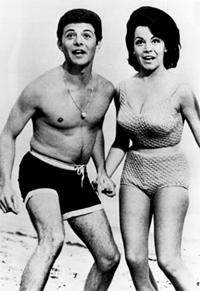
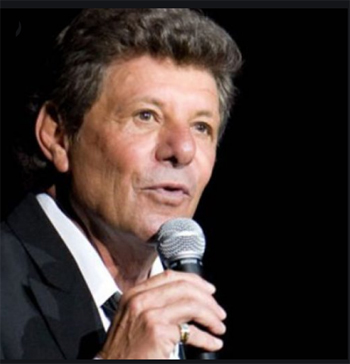
By 1962, Avalon's four-year
domination of the charts was coming to an end, but his career wasn't. He teamed
up with Annette Funicello and reinvented himself as a
clean-cut, pretty-boy surfer in a wildly successful batch of Beach Party movies
that got him through the '60s in far better shape than most of his colleagues. The
series was big enough to bring himself and Funicello back for
an update in the '80s, Back to the Beach. Ever the
musician, Avalon insisted surf legend (and original cast
member) Dick Dale be in this revival.
Today, Avalon divides
his time between hawking pain medicine on home shopping networks and appearing
on the Golden Boys of Rock'n'Roll oldies show
with Bobby Rydell and Fabian,
looking handsome as ever.