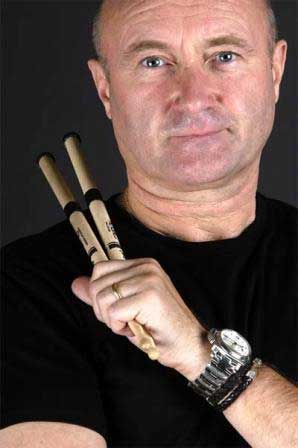
Phil Collins biography
Birth Name: Philip David Charles Collins
Born: January 30, 1951
Birth Place: London, England
Nationality: English
With a remarkable combination of middle-of-the-road appeal and talent
and vision that has produced some of the better music of his time,
composer-singer-drummer-actor Phil Collins has made an indelible impact on the
entertainment industry. Truly one of the hardest working men in show business,
he has written for and performed with two legendary and vastly different bands,
found great success as a solo artist and nursed a budding acting career, all at
the same time. While considering himself a drummer above all else, the musician
has written some of the most memorable songs in contemporary pop music and has
proven a powerful and universally recognizable singer. Because of his
unfaltering dedication to his craft and his place in Genesis, one of the most
influential rock bands of the day, Collins managed to win both popular success
and the respect of fellow musicians, hitting the top of the pop charts while
also being called upon to perform with such modern legends as Eric Clapton,
Sting, Robert Plant and Quincy Jones. His musical credibility and capability
have served well many a film that has procured his songwriting services.
After a short 1969 stint with the band Flaming Youth, the London-born
Collins auditioned for Genesis, then an up-and-coming progressive rock band fronted
by promising musical visionary Peter Gabriel. Hired as the band's drummer in
1970, he debuted on their 1971 album "Nursery Cryme". The drummer
first sang lead with the moving ballad "More Fool Me" from Genesis'
1973 concept album "Selling England By the Pound". Despite the
positive reaction to the track and the reality that Collins' voice was in many
ways technically superior to Gabriel's, when the front man left the art-rock
outfit to embark on his solo career, the remaining band members auditioned
hundreds of singers unsuccessfully before finally giving Collins lead vocal
duties in 1974. Genesis' first album without Gabriel was not released until two
years after his departure, but Collins kept busy as drummer of the fusion jazz
project Brand X, another experimental and influential combo. At varying times
throughout his career, the industrious Collins managed to record with Genesis
and Brand X concurrently, even while undertaking huge world tours with the former
as well as working on solo material.
Collins' work with Genesis began to move away from the band's original
epic laden art-rock foundation and into a more radio-friendly pop/R&B
inflected sound. This change grew more and more evident, and by 1981 Genesis
had scored a veritable pop hit with the brass-heavy "No Reply at All"
off their release "Abacab". That same year, Collins made his solo
debut with the album "Face Value", featuring
the haunting and timeless "In the Air Tonight". The album was a hit,
and the following year's follow up "Hello, I Must Be Going" was also a
success. A 1983 hit record for Genesis came next, and in 1984 Collins would pen
the love theme to "Against All Odds", a composition that became a
hugely successful single and garnered the songwriter an Oscar nomination and
Grammy award. Soon he would release the hit album "No Jacket Required" (1985) featuring no less than four
certified hit singles. That summer, the now-superstar was the only artist to
play on Live Aid stages in both London and Philadelphia.
While all of this solo success certainly kept Collins busy, it didn't
keep him from his original band - Genesis. 1986 saw Genesis release the
chart-topping album "Invisible Touch", an unprecedented success for
the band, with five of the album's eight tracks becoming top selling singles. In
the five years between "Invisible Touch" and Genesis' next release,
1991's "We Can't Dance", Collins released his fourth solo album,
1989's "...But Seriously", and earnestly tried his hand at an acting
career. The 1991 Genesis release and the two live albums chronicling the
supporting tour released that year would be Collins' swan song with the band. His
1993 solo album "Both Sides" didn't turn
out hit singles like his previous works had, but it was a notable and truly
solo effort: in addition to writing and singing all of the songs, Collins also
played every instrument on the album. In 1996 Collins stunned many fans by
announcing his departure from Genesis after 26 years. He decided that a solo
career was all he needed, plus the odd soundtrack, world tour etc., and he
released another album. The album, titled "Dance Into the Light" failed to radiate much Top 40 heat, and
Collins used this opportunity to try something new; indulging his lifelong
dream of playing in a jazz band, he formed the Phil Collins Big Band. The
project, with Collins on drums, performed standards and jazz instrumental
versions of some of his biggest hits. The Phil Collins Big Band did a successful
world tour in 1998, including two dates at the prestigious Montreaux Jazz
Festival. All the while, Collins was working on songs for Disney's
"Tarzan" (1999), an animated project that would help to firmly
reinstate him on the top of the charts.
An unquestionably gifted musician, Collins first pursued an acting
career, enrolling in a stage school with which his talent agent mother was
affiliated. From here, he landed an uncredited extra role as a screaming fan in
The Beatles' "A Hard Day's Night" (1964). He abandoned acting for
many years to focus on music, but those who watched Collins' stage theatrics
and hammy music video performances were not surprised when he began taking
small guest acting parts, notably a featured role in a 1985 episode of the
impossibly hip "Miami Vice" (NBC) that came hot on the heels of the
singer's chart-topping third solo effort and his amazing transcontinental Live
Aid performances. In 1988, he took the lead role in the comedy caper
"Buster", starring as the title thief who pulled off 1964's Great
Train Robbery. Relatively short in stature and balding, Collins proved a
charming and affable screen presence, with an open expressive face easy with
goofy expressions. In 1989, Collins was featured in The Who's twentieth anniversary
performance of their rock opera "Tommy", with an appropriately
repulsive portrayal of wicked Uncle Ernie. He followed up with a featured role
as a police inspector in 1991's "Hook" and next tackled drama,
sporting a greased up hairdo and mustache, looking every inch the part for his
role as a sleazy owner of a San Francisco bathhouse in 1993's exceptional HBO
production "And the Band Played On". That same year he played a
chillingly vacant-eyed insurance inspector in the Australian black comedy
"Frauds" and in 1995 took on a very different project, lending his
voice to a pair of polar bears in the animated children's feature
"Balto".
While Collins was a capable and likable actor, he proved, from his hit
love theme for "Against All Odds" to his moving song score for
Disney's "Tarzan", that his most notable
work in film made the most of his musical gifts. While he failed to score an
Academy Award (losing to Stevie Wonder's "I Just Called to Say I Love
You"), the track has proven more enduring than the film itself. As a
vocalist, Collins dueted with Marilyn Martin with the Stephen Bishop penned
1985 hit "Separate Lives" from "White Nights". His next project, 1988's "Buster" spawned
two hit songs, the original "Two Hearts" (which netted him a second
Oscar nod) and a cover of the 1960s syrupy "Groovy Kind of Love". He
was reportedly apprehensive about taking on the song score of "Tarzan",
faced with the task of writing in a storytelling style. His lyrical technique
was always more free-associative than intellectualized, the songwriter
admitting that even his oft-analyzed hit "In the Air Tonight" was not
really meant to be about anything at all. Working closely for over two years
alongside producers and animators, the perfectionist did countless drafts and
rewrites, and ended up with five inspired compositions for the Disney film. The
use of music in "Tarzan"
went in a different direction than the studio's past animated features, instead
of the character's singing the songs, Collins acted almost as a narrator, with
the songs as background accompaniment and the lyrics serving to forward the
story lines. The film's touching lullaby "You'll Be In My Heart"
lived up to the Disney standard for memorable theme songs, becoming a summer
hit single and showing certain potential to live on in popular consciousness.
Phil Collins went on to receive two Academy Awards for Tarzan - Best Film Score
and Most Original Song for "You'll Be In My Heart". He then co-wrote
the Score for the next Disney Release - "Brother
Bear" as well as contributed 5 new songs to the Soundtrack.