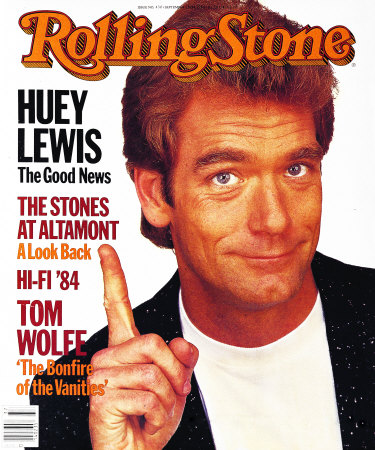
Huey Lewis & the News biography
Huey Lewis & the News were a
bar band that made good. With their simple, straightforward rock & roll,
the San Francisco-based group became one of America's most popular pop/rock
bands of the mid-'80s. Inspired equally by British pub rock and '60s R&B
and rock & roll, the News had a driving, party-hearty spirit that made
songs like "Workin' for a Livin',"
"I Want a New Drug," "The Heart of Rock & Roll,"
"Hip to Be Square" and "The Power of Love" yuppie anthems. At
their core, the group were a working band, and they knew how to target their
audience, writing odes to 9-to-5 jobs and sports. As the decade progressed, the
group smoothed out their sound to appeal to the aging baby boomers who adopted
them, but by the beginning of the '90s, the appeal of their formula had
decreased. Nevertheless, the group remained a popular concert attraction, and
they continued to have radio hits on adult contemporary stations.
The roots of Huey Lewis & the News
lay in Clover, an early-'70s country-rock band from San Francisco that featured
Lewis (vocals, harmonica) and keyboardist Sean Hopper. Clover moved to England
in 1976 upon the urging of Nick Lowe, who believed they could fit into the U.K.'s pub rock scene. In a short time, the group
cultivated a small following. Lowe produced the group's first single,
"Chicken Funk," which featured lead vocals by Lewis and, the
following year, the band, minus Lewis, supported Elvis
Costello on his debut album, My Aim Is True. Polygram
released two Clover albums that failed to find an audience and when their
leader, John McFee, left the group to join the Doobie Brothers, the band broke up and returned to
California. Before returning to the States, Lewis played harmonica on Lowe's
Labour of Lust and Dave Edmunds' Repeat When Necessary, which also featured
Lewis' song "Bad Is Bad."
Upon their return to America, Lewis and
Hopper began jamming at a Marin County bar called Uncle Charlies,
which is where they formed American Express with Mario Cipollina
(bass), Johnny Colla (saxophone, guitar) and Bill
Gibson (drums), who had all played in Soundhole, one
of Van Morrison's backing bands in the late '70s. American Express recorded a
disco version of "Theme From Exodus,"
calling it "Exodisco." Mercury released the
single, which was ignored. In 1980, the group added lead guitarist Chris Hayes
and were offered a contract by Chrysalis who requested that the band change
their name. The members chose Huey Lewis & the News and the band's
eponymous debut was released later that year to little
attention.
Picture This,
the group's second album, was released early in 1982 and the record became a
hit on the strength of the Top Ten single "Do You Believe in Love,"
which was written by former Clover producer Robert John "Mutt" Lange.
A couple other minor hits, "Hope You Love Me Like
You Say You Do" and "Workin' for a Livin'" followed, and the band began building a strong
following by touring heavily. Sports, the group's third
album, was released in the fall of 1983 and it slowly became a
multi-platinum success, thanks to touring and a series of clever, funny videos
that received heavy MTV airplay. "Heart and Soul" (number eight,
1983), "I Want a New Drug" (number six, 1984), "The Heart of
Rock & Roll" (number six, 1984) and "If This Is It" (number
six, 1984) all became Top Ten hits, and Sports climbed to number one in 1984;
it would eventually sell over seven million copies. Late in 1984, Lewis sued
Ray Parker, Jr., claiming that his song
"Ghostbusters" plagiarized "I Want a New Drug." The suit
was settled out of court. The News had their first number one single in 1985
with "The Power of Love," taken from the soundtrack to Back to the
Future.
Huey Lewis & the News returned with
their fourth album, Fore!, in 1986. The record sailed
to number one on the strength of five Top Ten singles: "Stuck With
You" (number one, 1986), "Hip to Be Square" (number three,
1986), "Jacob's Ladder" (number one, 1987), "I Know What I Like"
(number nine, 1987), and "Doing It All for My Baby" (number six,
1987). The band was riding high on the charts when they decided to expand their
musical reach with 1988's Small World, dipping tentatively into various
American roots musics. While the record produced the
Top Ten hit "Perfect World," it was a commercial disappointment after
two chart-topping, multi-platinum albums, stalling at number 11 on the charts
and only going platinum.
The News took three years to follow up
Small World with Hard at Play, which was released on their new label, EMI. Hard
to Play failed to break the Top 20 and only produced one hit, "Couple Days
Off." The group's commercial heyday had clearly passed, and the group took
the remainder of the '90s rather easy, touring sporadically and releasing the
covers album Four Chords & Several Years Ago in 1994. Their first release
for Elektra Records, the album generated one adult contemporary radio hit,
"But It's Alright," and failed to go gold