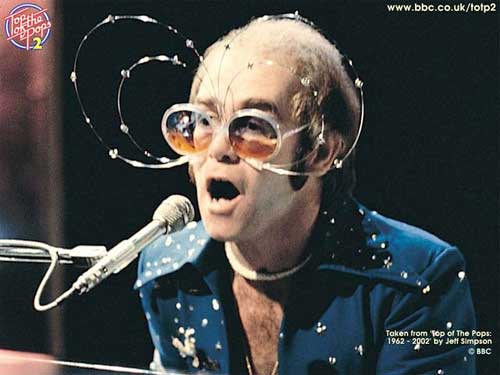
Elton John biography
BORN: March 25, 1947, Pinner,
In terms of sales and lasting popularity, Elton John was the biggest pop
superstar of the early '70s. Initially marketed as a
singer/songwriter, John soon revealed he could craft Beatlesque
pop and pound out rockers with equal aplomb. He could dip into soul, disco and
country, as well as classic pop balladry and even progressive rock. His
versatility, combined with his effortless melodic skills, dynamic charisma and
flamboyant stage shows made him the most popular recording artist of the '70s. Unlike
many pop stars, John was able to sustain his popularity, charting a Top 40
single every single year from 1970 to 1996.
During that time, he had temporary slumps in creativity and sales, as he fell
out of favor with critics, had fights with his
lyricist Bernie Taupin, and battled various
addictions and public scandals. But through it all, John remained a remarkably
popular artist and many of his songs -- including "Your Song,"
"Rocket Man," "
The son of a former Royal Air Force trumpeter, Elton John was born Reginald
Kenneth Dwight in 1947. Dwight began playing piano at the age of four, and when
he was 11, he won a scholarship to the Royal Academy of Music. After studying
for six years, he left school with the intention of breaking into the music
business. In 1961, he joined his first band, Bluesology,
and divided his time between playing with the group, giving solo concerts at a
local hotel, and running errands for a
In 1966, Bluesology became Long John Baldry's supporting band, and began touring cabarets
throughout
John and Taupin were hired by Dick James to become
staff songwriters at his fledgling DJM in 1968. The pair collaborated at a
rapid rate, with Taupin submitting batches of lyrics
-- he often wrote a song an hour -- every few weeks. John would then write
music without changing the words, sometimes completing the songs in under a
half hour. Over the next two years, the duo wrote songs for pop singers like
Roger Cook and Lulu. In the meantime, John recorded cover versions of current
hits for budget labels to be sold in supermarkets.
By the summer of 1968, he had begun recording singles for release under his own
name. Usually, these songs were more rock and radio-oriented than the tunes he
and Taupin were giving to other vocalists, yet
neither of his early singles for Phillips, "I've Been Loving You Too
Long" and "Lady Samantha," sold well. In June of 1969, he
released his debut album for DJM, Empty Sky, which received fair reviews, but
no sales.
For his second album, John and Taupin hired producer
Gus Dudgeon and arranger Paul Buckmaster, who contributed
grandiose string charts to Elton John. Released in the summer of 1970, Elton
John began to make inroads in
John followed it quickly in February 1971 with the concept album Tumbleweed
Connection, which received heavy airplay on album-oriented radio in the
Between 1972 and 1976, Elton John and Bernie Taupin's
hit-making machine was virtually unstoppable. "Rocket Man" began a
four-year streak of 16 Top 20 hits in a row; out of those 16 -- including
"Crocodile Rock," "Daniel," "Bennie and the
Jets," "The Bitch Is Back" and "Philadelphia Freedom"
-- only one, the FM hit "Saturday Night's Alright for Fighting,"
failed to reach the Top Ten. Honky Chateau began a streak of seven consecutive
number one albums -- Don't Shoot Me I'm Only the Piano Player (1973), Goodbye
Yellow Brick Road (1973), Caribou (1974), Greatest Hits (1974), Captain
Fantastic and the Brown Dirt Cowboy (1975), Rock of the Westies
(1975) -- that all went platinum. John founded Rocket, a record label
distributed by MCA, in 1973 in order to sign and produce acts like Neil Sedaka and Kiki Dee.
John didn't become a Rocket recording artist himself, choosing to stay with MCA
for a record-breaking eight million dollar contract in 1974. Later in 1974, he
co-wrote John Lennon's number one comeback single, "Whatever Gets You
Through the Night," and he persuaded Lennon to join him onstage at
Throughout the mid-'70s, John's concerts were enormously popular, as were his
singles and albums, and he continued to record and perform at a rapid pace
until 1976. That year, he revealed in an interview in Rolling Stone that he was
bisexual; he would later admit that the confession was a compromise, since he
was afraid to reveal that he was homosexual. Many fans reacted negatively to
John's bisexuality, and his audience began to shrink somewhat in the late '70s.
The decline in his record sales was also due to his exhaustion. After 1976,
John cut his performance schedule drastically, announcing that he was retiring
from live performances in 1977 and started recording only one album a year.
His relationship with Taupin became strained
following the release of 1976's double-album Blue Moves, and the lyricist began
working with other musicians. John returned in 1978 with A Single Man, which
was written with Gary Osborne; the record produced no Top 20 singles. That
year, he returned to live performances, first by jamming at the Live Stiffs
package tour, then by launching a comeback tour in 1979 accompanied only by
percussionist Ray Cooper. "Mama Can't Buy You Love," a song he
recorded with Phillie soul producer Thom Bell in
1977, returned him to the Top Ten in 1979, but that year's Victim of Love was a
commercial disappointment.
John reunited with Taupin for 1980's 21 at 33, which
featured the Top 10 single "Little Jeannie." Over the next three
years, John remained a popular concert artist, but his singles failed to break
the Top 10, even if they reached the Top 40. In 1981, he signed with Geffen
Records and his second album, Jump Up! became a gold album on
the strength of "Blue Eyes" and "
Throughout the rest of the '80s, John's albums would consistently go gold, and
they always generated at least one Top 40 single; frequently, they featured Top
10 singles like "Sad Songs (Say So Much)" (1984), "Nikita"
(1986), "Candle in the Wind" (1987), and " I Don't Want To Go On
With You Like That" (1988). While his career continued to be successful,
his personal life was in turmoil. Since the mid-'70s, he had
been addicted to cocaine and alcohol, and the situation only worsened during
the '80s. In a surprise move, he married engineer Renate Blauel in 1984; the couple stayed married for four years,
although John later admitted he realized he was homosexual before his marriage.
In 1986, he underwent throat surgery while on tour in 1986, but even after he
successfully recovered, he continued to abuse cocaine and alocohol.
Following a record-breaking five-date stint at
In 1992, John returned to active recording with The One. Peaking at number
eight on the
Biography by 10-year-old Laura Chase (saintjohnbarbie@hotmail.com)
Elton John was the single most successful pop artist of the '70s, and he
continued to score hits for decades after his initial reign of popularity. Born
Reginald Dwight in Pinner,