Kenny Loggins
biography
While never viewed as an especially
cutting-edge performer, Kenny Loggins (b. Jan. 7,
1947, Everett, Wash.) has managed to stay in business, integrity and sales
intact, longer than almost all of his contemporaries. From country-rocking
folkie to slick pop star to ubiquitous soundtrack presence, Loggins
has, in the course of two decades, shifted his approach to music-making skillfully and without much noticeable compromise. Maybe he
has gone the soundtrack route once too often--but consistent top 10 singles
are, after all, awfully difficult to argue with.
Like many of his contemporaries, Loggins
started out in comparative obscurity; he recorded with two little known
late-'60s rock bands (Gator Creek and Second Helping) before signing a
publishing deal with ABC/Wingate. As a result of that deal, the Nitty Gritty Dirt Band recorded four of his
songs and scored a small hit in 1971 with "House At
Pooh Corner." Columbia Records then stepped in and offered Loggins a recording contract. His first album's slated
producer, former Buffalo Springfield / Poco member
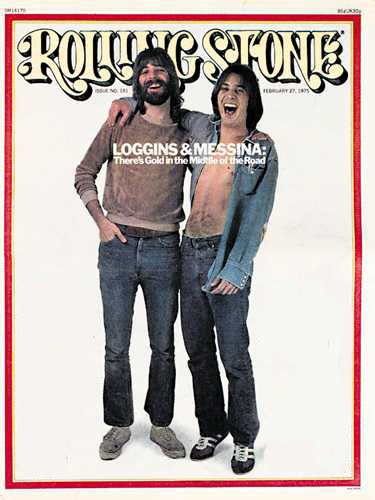
Jim Messina, became so involved with the recording it was credited to
"Kenny Loggins with Jim Messina"--and thus
began one of the more lucrative musical partnerships of the '70s. Together
through 1976, Loggins & Messina
recorded two platinum and five gold albums, and scored a top 5 single in 1972
with the jointly-penned "Your Mama Don't Dance" (which again hit the
top of the charts 17 years later when covered by hard rock group Poison).
"It was one of the highlights of my life,"
Jim Messina said years later of his time with Loggins.
"I considered my relationship with Kenny in the beginning very special,
and a creative relationship. I learned a lot from him as a singer, and he
helped me indirectly as a writer--in the sense that he was a very quality
writer. There was a creative competitiveness there, a healthy competitiveness,
that I think brought both of us up to a real special place."
Significantly, though, when Loggins
and Messina split, it was Loggins' career that took
off, while Messina's floundered by comparison. Loggins'
first three solo albums each went platinum--Celebrate Me Home, Nightwatch and Keep The Fire,
all released between 1977-79--and, maybe more importantly, Loggins
was striking up musical relationships with some of the dominant musical forces
of the era. To wit: Fleetwood Mac's Stevie
Nicks, who sang on the top 10 single "Whenever I Call You
Friend," and the Doobie Brothers' Michael
McDonald, with whom Loggins had written
"What A Fool Believes" (a No. 1 Doobies hit
in '79) and "This is It," a top 20 hit for Loggins,
among many other tracks.
The next phase in Loggins'
career is in some ways the most controversial: A series of hit singles from
film soundtracks that, despite their success, may have altered the industry's
perception of the singer. The onetime album rock staple was hitting top 40
radio regularly with hits from Caddyshack
("I'm Alright"), Footloose (the title track,
written by Loggins and Dean Pitchford,
topped Billboard's Hot 100 for three weeks and went platinum), Top
Gun ("Danger Zone"), Over The Top ("Meet
Me Halfway"), and even Caddyshack
II (top 10 hit "Nobody's Fool"). What was the downside?
First, Loggins had nothing to do with the writing of
either "Danger Zone" or "Meet Me Halfway"- Giorgio
Moroder and Tom Whitlock did--and secondly, few of those hits were to be
found anywhere on his own albums, which had stopped their regular ascension to
the top 40 with 1982's High Adventure .
By the time Columbia issued Outside: From The Redwoods, Loggins'
live career retrospective of 1993, a notation in the CD booklet mentioned only
five albums that were "also available from Kenny Loggins."
Curiously not listed were 1980's Alive, 1982's High Adventure,
and, most surprisingly, Back To Avalon,
a comparatively recent 1988 effort. Did this mean Loggins'
audience was vanishing? Not likely--his 1991 album Leap Of Faith had gone gold, after all, and included
well-known adult contemporary hits like "I Would Do Anything" and
"If You Believe." More likely, Loggins'
"adult contemporary" audience was simply growing up and away--and wisely,
like other singer-songwriters of his vintage, Loggins
was preparing for it. By 1996, the co-writer of "Your Mama Don't
Dance" had released Return To Pooh Corner
on Sony Wonder, the children's division of his label.