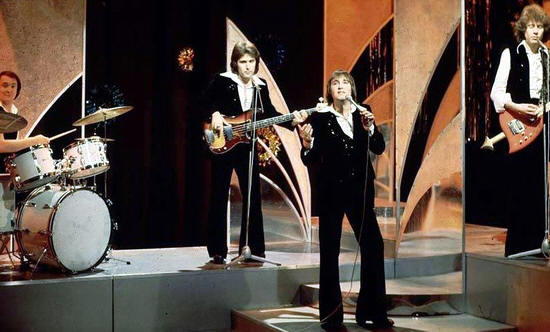
Mud
biography
Mention the name Mud to most Americans -- even those
neck-deep in the '70s revival -- and the likely result will be a blank stare. In
England, however, between 1974 and 1976, Mud were one of the hottest rock &
roll acts there was, charting a series of monster hit singles and recording a
pair of delightful oldies-oriented albums. They were never a profoundly
philosophical band, and never pretended to be -- the group played music to have
a good time, and merely asked that others join in,
which millions of Brits did for a few years.
Fate, in the guise of producer Mickie Most,
took a hand in the early '70s. Most was impressed with their stage presentation
and hooked them up with the songwriting- producer
team of Nicky Chinn and Mike Chapman (known corporately as Chinnichap).
They came up with "Crazy" and "Hypnosis," a pair of singles
that made the Top 20 for the group in 1973 on Most's
RAK label -- this was better than any of their previous singles had done, but
still weren't representative of the group's sound.
Lightning struck a third time late 1973 when Mud inherited a
Chinn/Chapman song that had been rejected by the Sweet, called "Dyna-mite." Driven by a crunchy "Long Cool
Woman"-type guitar intro, "Dyna-mite"
was a catchy rocker that became a top five British hit, but it also had a
profound effect on the direction of the band. It required Les Gray to sing in a
style akin to that of Elvis Presley, and a sound and direction were beginning
to be established for the group. Their next single, "Tiger Feet,"
topped the English charts in early 1974, riding the number one spot for a
month, and they followed this with "The Cat Crept In," a top three
British hit. "The Cat Crept In," in particular, was written to
exploit Les Gray's propensity to imitate Elvis
Presley, and the band was quite obviously having the time of its life joining
in the proceedings -- Chapman continued returning to the formula. The group
treated all of this as a lark. They were grateful for the hits, and didn't feel
compelled to worry over their artistic development in the way of a lot of other
acts -- they'd started out in music to have a good time, and they were having
it. Their musical competency and visual presentation -- particularly Rob Davis'
willingness to ornament himself with dangling jewelry -- positioned them perfectly for the glam-rock
boom, and the Chinn-Chapman songs made for catchy singles.
After three hit singles, an album seemed a logical next step, and one
was knocked off in mid-1974, called Mud Rock, done as a fake live performance
which included a medley of the three hits and a series of covers of classic
rock & roll, everything from the Contours' "Do You Love Me" and
Chuck Berry's "Bye Bye Johnny" to a Marcels'-style rendition of Rodgers & Hart's "Blue
Moon," with a nod to big-band music in the form of "In the
Mood." Mud Rock sold well, and the band might've
gone on perfectly well this way, cutting hit singles and doing an LP once a
year, but for a problem that came up late in 1974, when Mud was persuaded to
sign a contract with the new Private Stock label.
They were still under contract to Mickie Most,
and the Chinn-Chapman songwriting team kept providing
the band with retro-style songs, including "The Secrets That You
Keep," another top three British single in early 1975. Their next single,
a cover of Buddy Holly's "Oh Boy!" that made number one in England,
was an outgrowth of the session that yielded "Blue Moon" -- the Holly
song was suggested as a follow-up at the time, cut for the second album, and
then culled as a single. By then, the band had left RAK, and suddenly, they
found themselves in the awkward position of competing with themselves -- before
they could get anything out on Private Stock, RAK had a succession of hit
singles (including a version of "One Night," a direct Elvis Presley
cover). Their second album, rather unimaginatively titled Mud Rock, Vol. II,
yielded over a million sales in singles drawn from its line-up of songs.
Mud were
in it for the fun. Have a laugh, have a bit of a giggle and then get out. They
used to appear in stretchy Dra-lon trousers and did
the cheesiest dance imaginable to the worst song this side of Lieutenant
Pigeon. But it got a bit carried away with itself, and the band found that they
were a bit more popular than I suspect they ever figured they would be. But Mud
were so of their time that a long-term career was
never an option.
After the Glam bubble burst in 1976 they disappeared, jettisoned by
their public like an empty fuel tank. Sir Les kept going (in his tight white lurex trousers), renaming the band
Les Gray's Mud. The band continued touring until 1997
when ill health tapped Les on the shoulder - a bill from the early Seventies.