Gilbert O’Sullivan biography
Singer/songwriter
Gilbert O'Sullivan successfully combined
a flair for Beatlesque popcraft with an old-fashioned musichall sensibility to emerge as one of the most distinctive
and popular new performers of the early 1970s. Born Raymond O'Sullivan in Waterford,
Ireland on December 1,
1946, he went on to attend
art school in Swindon,
England, writing songs throughout his formative years
and sending out demo tapes to little avail. After graduating he went to work in a London department store; one of his co-workers there was under contract with CBS, and soon O'Sullivan was signed to the label as well. Early singles like
"What Can I Do?"
and "Mr. Moody's Garden" were released to little attention, however, and so O'Sullivan sent
his demo to impressario
Gordon Mills, whose MAM label
was home to superstars like Tom Jones and Engelbert Humperdinck; the gambit worked,
and his first single for MAM, "Nothing Rhymed," became a Top Ten UK
hit in late 1970.
The wit and craft
of O'Sullivan's music aside, much of his early success was predicated on his unusual image
-- at the peak of the hippie movement,
he resembled nothing so much as a Depression-era street urchin, complete with pudding-bowl
haircut, short pants and flat cap. Subsequent hits including "We Will" and "No Matter How
I Try" followed, and
in 1971 O'Sullivan issued his debut
LP, Himself; a year later, he finally broke through to the American market with the ballad
"Alone Again (Naturally)," which topped the U.S. pop charts. Around
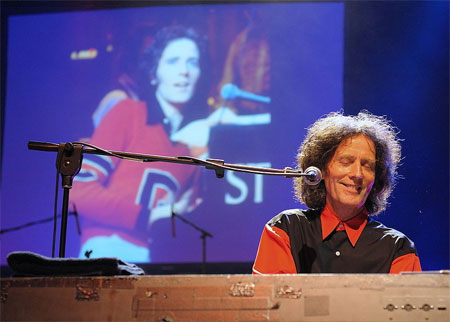
this time, the singer jettisoned his so-called "Bisto Kid"
image in favor of an endless
series of collegiate-styled
sweaters embossed with the letter
"G." In late 1972, O'Sullivan scored his first British number one with
"Clair," falling
just shy of topping charts on the other
side of the Atlantic; the follow-up, "Get Down," reached number one at home
as well, as did the LP Back
to Front.
As quickly
as O'Sullivan ascended to fame,
however, his star began to
fall -- although singles like "Ooh Baby" and
"Happiness Is Me and You" continued to chart, they sold increasingly
fewer copies, and after 1973 his overseas popularity essentially ceased altogether. At home, he notched his final Top 20
hit with 1975's "I Don't Love You
But I Think I Like You," subsequently leaving MAM after a well-publicized dispute with Gordon Mills; returning to CBS, albums like 1977's Southpaw and 1980's
Off Centre failed to find an audience,
and outside of the minor hit "What's in a Kiss?" O'Sullivan
disappeared from the charts. In 1982 he took Mills to court, ultimately winning back the master tapes
to his recordings as well as the
copyrights to his songs; in
1991, O'Sullivan was again victorious
thanks to a judge's landmark ruling that rapper Biz
Markie's unauthorized sample from "Alone Again (Naturally)"
was in fact theft.
Regrettably, O'Sullivan's court appearances constituted his highest public profile during this period
-- after releasing the Graham Gouldman-produced Life
and Rhymes in 1982, he did not issue another
new LP until Frobisher Drive five years later. In the Key of G followed in 1989,
and although none of these records made
an impact on the charts they did
appeal to the singer's small but fiercely devoted
cult audience, much of it now
centered in Japan -- indeed,
O'Sullivan's next three releases (1992's Rare
Tracks, The Little Album and 1993's Live in Japan, respectively) were initially issued only in Asian markets,
and he performed live there
regularly. O'Sullivan remained
a prolific talent throughout the decade to follow, with subsequent LPs including 1993's Sounds of the Loop, 1994's By Larry, 1995's Every Song Has Its Play and
1997's Singer Sowing Machine.
~