Webb Pierce biography
Webb Pierce was one of the most popular honky tonk vocalists of the '50s, racking up more number one hits
than similar artists like Hank Williams, Eddy Arnold, Lefty
Frizzell, and Ernest Tubb.
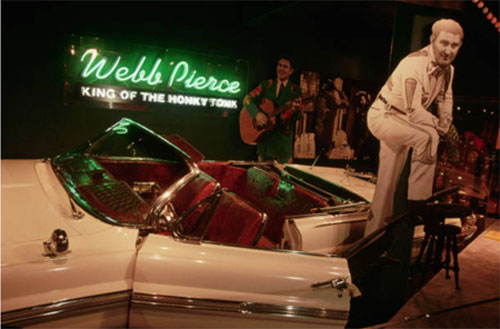
For most of the general public, Pierce - with his lavish,
flamboyant Nudie suits - became the most recognizable face of country music, as
well as all of its excesses; after all, he boasted about his pair of
convertibles lined with silver dollars and his guitar-shaped swimming pool.
As a child in
After WW II Pierce began singing on radio stations,
nightclubs, and dances with his wife Betty Jane. At first, they were featured
on an early morning radio show on KTBS, while they would perform in the evening
at clubs. It took them five years before they were
noticed by the industry. In 1949, the California-based 4 Star Records signed
the duo under separate recording contracts. Webb signed under
his own name, while his wife was signed for duets with her husband under the
name Betty Jane and Her Boyfriends. However, success didn't come to the duo -
it only came for Webb; in the summer of 1950, the couple divorced.
In late 1949, Pierce accepted a spot on the Louisiana
Hayride, a radio program on KWKH that was instrumental in launching the careers
of many country artists. Webb began to assemble a band of
local
Pierce continued to have hits until the end of the '50s, but he did take
a significant dip in popularity after rock & roll's arrival in the late
'50s. Nevertheless, Pierce stayed on the charts, primarily
because he kept in close touch with DJs across the country, which meant that he
was able to keep his streak of 34 consecutive Top Ten hits running into 1957.
By 1965, the country-pop leanings of the Nashville Sound had pushed
honky tonk from the top of the country charts. Pierce remained
a star, but he simply didn't have many big hits in the latter half of the '60s
-- the most notable was "Fool Fool Fool" in 1967. Since his music had faded from the
spotlight, he became known for his excessive lifestyle. Instead of indulging in
intoxicants, Webb indulged in material items. Pierce had
Nudie Cohen, a Hollywood tailor famous for his custom-made flamboyant clothing,
line two
Throughout the '70s, Pierce continued to record, but
most of his income came from his highly lucrative financial investments. Pierce left
Decca Records in 1975, making a handful of records for Plantation Records that
didn't experience much chart success. His last hit came in 1982, when his duet
on "In the Jailhouse Now" with Willie Nelson scraped
the bottom of the country charts.
Despite all of his success, Pierce was never inducted
into the Country Music Hall of Fame during his lifetime; it's likely that the
members never forgave him for his rejection of the Grand Ole Opry and the