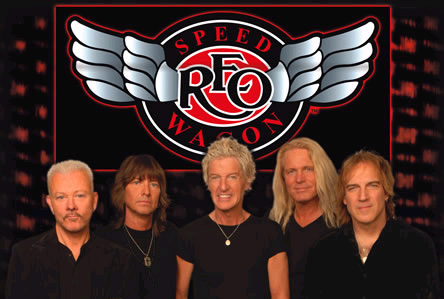
 REO Speedwagon
biography
Three bands were the undisputed arena rock
kings of the early '80s -- Styx, Journey, and REO Speedwagon
-- yet all weren't overnight success stories (in fact, each group began
pursuing different musical styles originally -- prog rock,
fusion, and straight-ahead hard rock, respectively, before transforming slowly
into chart-topping mainstream rockers). REO Speedwagon
first formed in 1968, via a pair of University of Illinois students,
keyboardist Neal Doughty and drummer Alan Gratzer.
After graduation, the group signed on with then-unknown manager Irving Azoff (who would later guide the careers of such
multi-platinum acts as the Eagles and Steely Dan), which led to the outfit
building a devoted following in the Midwest due to nonstop
touring.
By the early '70s, Doughty and Gratzer had welcomed aboard guitarist Gary Richrath, who would soon prove to be the group's sparkplug
(and one of rock's more underrated players), in addition to bassist Gregg Philbin and singer Terry Luttrell. It was this lineup to be featured on the quintet's 1971 self-titled
debut recording for Epic Records.
The debut failed to break REO through to the
mainstream, as the band's future was thrust into uncertainty shortly
thereafter, when Luttrell left the band. Newcomer Kevin Cronin got the gig, he was a folksinger/guitarist beforehand, with little
to no experience fronting a loud rock & roll outfit. The Cronin-led lineup appeared to be headed in the right direction though,
judging from 1972's R.E.O. 2, but the other members grew impatient with their
slow progress toward a commercial breakthrough, and gave Cronin his walking
papers. Up next as REO's frontman
was Mike Murphy, whose debut with the band, 1974's Ridin'
the Storm Out, was their first album to chart on Billboard and spawned a
concert standard with the rocking title track. Murphy stayed onboard for a
couple of more releases -- 1974's Lost in a Dream and
1975's This Time We Mean It -- but neither managed to push REO to the next
level.
Once more, a frontman change
was required, and instead of searching for a fresh new face, REO welcomed back
Cronin. The move paid off almost immediately, as REO found their niche by
streamlining their sound and focusing on melodic rockers aimed at radio, as
well as power ballads aimed at teenage girls' hearts. 1976's R.E.O. signaled the beginning of the veteran group's winning
streak, as both 1977's Live: You Get What You Play For and 1978's You Can Tune
a Piano, But You Can't Tuna Fish were REO's first to
earn gold and platinum certification. Another live album, Live Again, was also
issued in 1978, followed up a year later by another gold-certified hit, Nine
Lives. Although REO was slowly inching their way to big-time success, no one
(not even the band) could have predicted the massive hit that their next album
turned out to be, Hi Infidelity. Issued at the tail end of 1980, it became one
of 1981's biggest albums -- spawning one of the best-known power ballads of all
time, "Keep on Loving You," as well as such popular rock radio hits
as "Don't Let Him Go" and "Take It on the Run." Hi
Infidelity would eventually go on to sell more than nine million copies --
catapulting REO to arena-headlining status.
REO Speedwagon continued to
score further hit albums (1982's Good Trouble, 1984's Wheels Are Turnin') and singles ("Keep the Fire Burnin'," the number one hit power ballad "Can't
Fight This Feeling," etc.), but the hits dried up shortly thereafter.
1987's Life as We Know It managed to go gold, but their fans' sudden
disinterest coupled with turmoil between certain bandmembers
led to the exit of both Richrath and Gratzer by the end of the decade. REO opted to soldier on,
however, with replacement members Dave Amato (ex-Ted Nugent, guitar) and Bryan Hitt (ex-Wang Chung, drums) in tow, as their 14-track 1988
compilation The Hits proved to be a steady seller over the years. Further
underappreciated studio releases followed, such as 1990's The Earth, a Small
Man, His Dog and a Chicken and 1996's Building the Bridge. With interest at an
all-time low, REO was set to pack it up for good, until a sudden wave of
renewed interest in classic rock bands of yesteryear began to sweep the U.S.
during the late '90s, resulting in REO launching successful co-headlining tours
alongside such acts as Styx, Fleetwood Mac, Pat Benatar,
Foreigner, Peter Frampton, Journey, Lynyrd Skynyrd, and Bad Company, among others.
When REO returned to the studio later in the 2000s,
however, it was without Richrath. Find Your Own Way
Home, the band's first studio album of new songs in more than ten years,
featured Cronin along with founding member Neal Doughty on keyboards, longtime bassist Bruce Hall, and '80s additions Amato and Hitt.