The Seekers biography
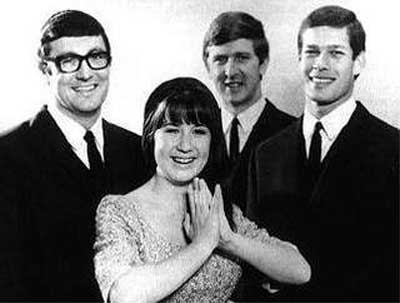
Founded in Australia in 1963, the original Seekers comprised Athol Guy
(b. 5 January 1940, Victoria, Australia; vocals/double bass), Keith Potger (b.
2 March 1941, Columbo, Sri Lanka; vocals/guitar), Bruce Woodley (b. 25 July
1942, Melbourne, Australia; vocals, guitar) and Ken Ray (lead vocals/guitar). After
a year with the above line-up, Athol Guy recruited Judith Durham (b. 3 July
1943, Melbourne, Australia) as the new lead singer
and it was this formation that won international success. Following a visit to London in 1964, the group
were signed to the Grade Agency and secured a prestigious guest spot on the
televised Sunday Night At The London Palladium. Tom Springfield, of the
recently defunct Springfields, soon realized that the Seekers could fill the
gap left by his former group and offered his services as songwriter/producer. Although
1965 was one of the most competitive years in pop, the Seekers strongly
challenged the Beatles and the Rolling Stones as the top chart act of the year.
A trilogy of folk/pop smashes, "I'll Never Find Another You", "A
World Of Our Own" and "The Carnival Is Over", widened their
appeal, leading to lucrative supper-club dates and frequent television
appearances. Aside from Tom Springfield's compositions, such as "Walk With
Me", they also scored a massive chart hit with Malvina Reynolds'
"Morningtown Ride" and gave Paul Simon his first UK success with a bouncy adaptation
of "Someday One Day". Meanwhile, Bruce Woodley teamed up with Simon
to write some songs, including the Cyrkle hit "Red Rubber Ball". In
early 1967, the breezy "Georgy Girl" (written by Tom Springfield and
Jim Dale) was a transatlantic Top 10 hit but thereafter, apart from "When
Will The Good Apples Fall" and "Emerald City",
the group were no longer chart regulars. Two years later they bowed out in a
televised farewell performance, and went their separate ways. Keith Potger
oversaw the formation of the New Seekers before moving into record production;
Bruce Woodley became a highly successful writer of television jingles; Athol
Guy spent several years as a Liberal representative in the Victoria parliament; and Judith Durham
pursued a solo singing career. She had a minor UK hit in 1967 with "Olive
Tree", and her 1973 album, Here I Am, contained songs by Rod McKuen,
Nilsson and Elton John, as well as some folksy and jazz material.
In 1975, the Seekers briefly re-formed with teenage Dutch singer Louisa
Wisseling replacing Judith Durham. They enjoyed one moment of chart glory when
"The Sparrow Song" topped the Australian charts. In 1990 Judith
Durham was involved in a serious car crash and spent six months recovering. The
experience is said to have inspired her to reunite the original Seekers, and
they played a series of 100 dates across Australia
and New Zealand, before
appearing in several 1994 Silver Jubilee Reunion Concerts in the UK at venues that included London's Royal Albert Hall and Wembley Arena.
The quartet has continued to tour throughout the world and in 2000 recorded
their first studio album for 30 years, Future Road.