 Barry White Biography
Say the name Barry White and you'd be hard pressed to follow
it with the name of any other recording artist with such a huge,
cross-sectional following. He was at home appearing on Soul Train, guesting with a full band on The Today Show, and appearing
in cartoon form in various episodes of The Simpsons. During the
'70s, Dinah Shore devoted a full hour of her daily syndicated Dinah! show to White. While there was a period
where Barry White wasn't releasing records or making the pop charts,
he did stay active touring and appearing on other artists' records
including Quincy Jones' "The Secret Garden (The Seduction
Suite)," Regina Belle, and rap star Big
Daddy Kane's "All of Me." It's surprising to find out that such an
illustrious career almost didn't happen because White wasn't
interested in being a recording artist.
Born in Galveston, TX, in 1944 Barry White grew up singing
gospel songs with his mother and taught himself to play piano. Shortly after
moving from Texas to South Central Los Angeles, White made his
recording debut at the tender age of 11, playing piano on Jesse Belvin's "Goodnight My Love." He made his first
record when he was 16 with a group called the Upfronts.
The song was called "Little Girl" on a local L.A. label called Lummtone Records. Later he worked for various independent
labels around Los Angeles, landing an A&R position with Bob Keane, the
man responsible for the first pop recordings by Sam Cooke. One of the
first groups he worked with for 40 dollars a week was the Versatiles who later changed their name to the
5th Dimension. White's first big hit came from an artist familiar to dancefloor denizens -- Viola Wills, whose "Lost
Without the Love of My Guy" went Top 20 R&B. His salary went up to 60
dollars a week. White started working with the Bobby Fuller
Four. Bob Keene and Larry Nunes -
who later became White's spiritual advisor and true friend - wanted to cut
a female act. White had heard about a singer named Felice Taylor. They had three hit records, "It May Be
Winter Outside," "I'm Under the Influence of Love," and "I
Feel Love Coming On." They were huge hits in England. White started making
400 dollars a week.
When Bronco went out of business, White began doing independent
production. Those were some lean times for White. Veteran
arranger Gene Page, who would later arrange or co-arrange White's
hits, helped him out, giving him work and non-repayable loans. Then three years
later, Paul Politti, who also worked at Bronco,
contacted him to tell him that Larry Nunes was
interested in starting a business with him. Nunes had
started cutting tracks for a concept album he was working on. Meanwhile, White had
started working with this girl group who hadn't done any singing professionally.
They rehearsed for almost a year. White wrote "Walkin' in the Rain (With the One I Love)" with lyrics
that were inspired by conversations with one of the singers, Glodean James (who would later become White's
second wife). White christened the group Love Unlimited. Larry Nunes took the record to Russ Regan, who was the
head of the Uni label owned by MCA. Love Unlimited's From a Girl's Point of View became a
million-seller.
In 1973 White produced the first Barry White album. That first
album was I've Got So Much to Give on 20th
Century Records. It included the title track and "I'm Gonna
Love You Just a Little More Baby."
White got a release from Uni
for Love Unlimited and they joined him over at 20th Century Records. Then
he had a brainstorm for another concept album. He told Regan he
wanted to do an instrumental album. Regan thought he had lost
it. White wanted to call it the Love Unlimited Orchestra. The
single, "Love's Theme," went to number one pop, was a million-seller,
and was a smash all over the world. The song earned him a BMI award for over
three million covers.
For the next five years, from 1974 to 1979, there was no stopping
the Barry White Hit Train - his own Stone Gon,
Barry White Sings Love Songs for the One You Love ("It's Ecstasy When You
Lay Down Next to Me," "Playing Your Game Baby"), Let the
Music Play (title track, "You See the Trouble with
Me"), Just Another Way to Say I Love You ("I'll Do for You
Anything You Want Me To," "Love Serenade"), The
Man ("Your Sweetness Is My Weakness," "Sha
La La Means I Love You," "September When We
Met," a splendid cover of Billy Joel's "Just the Way You
Are"), and Love Unlimited's In
Heat ("I Belong to You," "Move Me No Mountain,"
"Share a Little Love in Your Heart," and "Love's Theme,"
with lyrics). He also scored a soundtrack for the 20th Century Fox film The
Together Brothers, enjoying a resurgence on home
video. Then it all derailed as Russ Regan and another ally, Hosea
Wilson, left 20th Century Records and White was left with management
that he thought of in less than glowing terms.
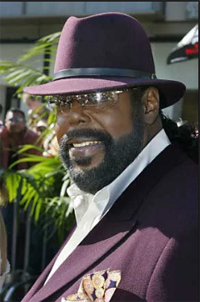 However, after
eight Barry White albums, four Love Unlimited albums,
four Love Unlimited Orchestra albums, constant touring, and dealing
with the rigors of the music industry, White decided to take a break.
However, after
eight Barry White albums, four Love Unlimited albums,
four Love Unlimited Orchestra albums, constant touring, and dealing
with the rigors of the music industry, White decided to take a break.
Then in 1992, White signed with A&M, releasing the
albums The Man Is Back, The Right Night & Barry White,
and Put Me in Your Mix (which contains a duet with Issac Hayes, "Dark and Lovely"). The Icon Is
Love became his biggest-selling album since the '70s releases, going
multi-platinum. It includes the platinum single "Practice What You
Preach." While some later efforts buried his vocals in whiz-bang
electronic effects, on The Icon Is Love, White's deep steam engine
baritone pipes are upfront in the mix. Staying Power followed in
1999, showcased in the best tradition of soul music where the focus is the
singer and the song. The album earned White two Grammys. White's career
took him from the ghetto to international success with 106 gold and 41 platinum
albums, 20 gold and ten platinum singles, with worldwide sales in excess of 100
million.
White, who suffered from hypertension and chronic high blood pressure,
was hospitalized for kidney failure in September of 2002. He was undergoing
dialysis treatment, but the combination of illnesses proved too much and he
died July 4, 2003 at a West Hollywood hospital. By the time of his
death, Barry White had achieved a near-universal acclaim and
popularity that few artists achieve and even fewer within their own lifetime.