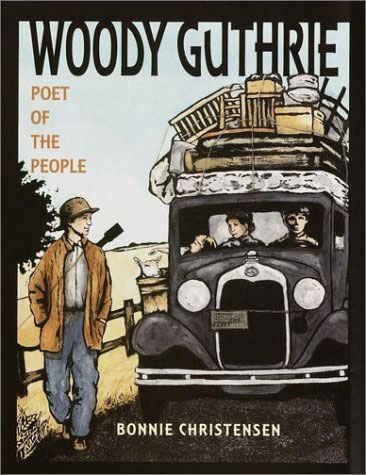
Woody Guthrie biography
Woody was the second-born son to Charles and Nora Belle Guthrie. His
father was a cowboy, land speculator, and local politician. His Kansas-born
mother profoundly influenced Woody in ways which would become apparent as he
grew older. Slightly built, with an extremely full and curly head of hair,
Woody was both a precocious and unconventional boy from the start. A keen
observer of the world around him, during his early years in Oklahoma, Woody
experienced the first in a series of tragic personal losses - the death of his
older sister, Clara - would haunt him throughout his life. This followed by the
financial and physical ruin, and the institutionalization of his mother would
devastate Woody's family and home, forming a uniquely wry and rambling outlook
on life.
In 1931, when Okemah's boomtown period went bust, Woody left for
By the time he arrived in
Never one to become comfortable with success, or being in one place for too
long, in 1939 Woody headed east for New York City, where he was embraced for
his Steinbeckian homespun wisdom and musical
"authenticity" by leftist organizations, artists, writers, musicians,
and other intellectuals. "..I sang at a hundred
Lead Belly, Cisco Houston, Burl Ives, Pete Seeger,
Will Geer, Sony Terry, Brownie McGhee, Josh White, Millard Lampell,
Bess Hawes, Sis Cunningham, among others, became Woody's friends and
collaborators, taking up such social causes as Union organizing, anti-Fascism,
strengthening the Communist Party, and generally fighting for the things they
believed in the only way they knew how: through political songs of protest.
In 1940, folklorist Alan Lomax
recorded Woody in a series of conversations and songs for the Library of
Congress. Also during the 1940s, Woody recorded extensively for Moses Asch, founder of Folkways Records. The recordings from this
period, which have been reissued under the Smithsonian Folkways label, continue
to be touchstones for young folk music singers/songwriters everywhere.
Woody Guthrie continued to write songs and perform with the Almanac Singers,
the politically radical singing group of the late 1940s, some of whose members
would later re-form as the Weavers, the most commercially successful and
influential folk music group of the late 1940s and early 1950s. Managed by
Harold Leventhal, a trusted friend and confidante,
and supported by music publisher Howie Richmond, the
Almanacs helped to establish folk music as a viable commercial entity within
the popular music industry.
Becoming increasingly restless and disillusioned with
Leaving
Despite Woody's constant traveling and
performing during the 1940s, and with the final dissolution of his first
marriage, Woody strenuously courted an already married young Martha Graham
dancer named Marjorie Mazia. Woody and Marjorie were
married in 1945.
This relationship provided Woody a level of domestic stability and
encouragement which he had previously not known, enabling him to complete and
publish his first novel, Bound for Glory, in 1943. A semi-autobiographical
account of his Dust Bowl years, Bound for Glory generally received critical
acclaim. Together, Woody and Marjorie had four children: Cathy, who died at age
four in a tragic home accident, Arlo, Joady, and Nora Lee.
Moved by his passion against fascism, during World War II, Woody served in both
the Merchant Marine and the Army, shipping out to sea on several occasions with
his buddies Cisco Houston and Jimmy Longhi.
In one of many anti-Fascist songs written during the war, Woody tells us:
We were seamen three, /
Cisco, Jimmy and me
Shipped out to beat
the fascists / Across the land and sea.
Throughout his tours of duty, as in civilian life, Woody's penchant for
writing and drawing continued unabated. His capacity for creative
self-expression seemed inexhaustible, whether on land or sea.
In 1946, Woody Guthrie returned to settle in
Becoming more and more unpredictable during a final series of road
trips, Woody eventually returned to
In 1954, Woody admitted himself into
Well, it's always we
ramble that river and I
All along your green
valley, I'll work till I die
My land I'll defend
with my life, if it be
'Cause my pastures of
plenty must always be free.
- Pastures of Plenty
Having lived through some of the most significant historic movements and
events of the Twentieth-Century --the Great Depression, the Great Dust Storm,
World War II, the social and the political upheavals resulting from Unionism,
the Communist Party and the Cold War-- Woody absorbed it all to become a
prolific writer whose songs, ballads, prose and poetry captured the plight of
every man. While traveling throughout the American
landscape during the 1930s, '40s, and '50s, Woody's observations of what he saw
and experienced has left for us a lasting and sometimes haunting legacy of
images, sounds, and voices of the marginalized, disenfranchised, and oppressed
people with whom he struggled to survive despite all odds. Although the corpus of original
Woody Guthrie songs, or as Woody preferred "people's songs" are,
perhaps, his most recognized contribution to American culture, the stinging
honesty, humor, and wit found even in his most
vernacular prose writings exhibit Woody's fervent belief in social, political,
and spiritual justice.
Recognition of Woody Guthrie's work lives on. He has been inducted into The Songwriters' Hall of Fame (1971),
the Nashville
Songwriters' Hall of Fame (1977), and The Rock and Roll Hall of Fame and
Museum (1988). He has received numerous awards, including the
U.S. Department of
the Interior's Conservation Award (1966), The Folk Alliance Lifetime
Achievement Award (1996), and a Grammy from the National Academy of Recording Arts
and Sciences (1999). In 1996, The Rock and Roll Hall of Fame and Museum and Case Western Reserve University
presented a ten day celebration honoring Woody
Guthrie, entitled Hard Travelin'. It
was the first major conference on the legacy of Woody Guthrie complete with a
photo exhibition, lectures, films, and two benefit concerts, which were held in
support of the Woody Guthrie Archives.
Popular and folk musicians such as Bruce Springsteen, Billy Bragg, Wilco, Ani DiFranco, and
countless others, continue to draw inspiration from Woody Guthrie,
re-interpreting and re-invigorating his songs for new audiences. Pete Seeger,
Bob Dylan,
Arlo Guthrie, and Ramblin' Jack Elliot,
are among the legions of folk musicians, of every age-group, who are carrying
the tradition of the harmonica and guitar-playing singer/songwriter into the
future. New books and publications of Woody's words and drawings, and even a
children's book, This Land is Your Land
by folk artist Kathy Jakobsen, have brought Woody
Guthrie back into the mainstream of popular culture. The Smithsonian
Institution and the Woody Guthrie Foundation and Archives have collaborated on
a major traveling exhibition about Woody's life and
legacy allowing thousands of people to view for themselves Woody's
artwork, writings, and songs.
Clearly, Woody Guthrie's songs continue to speak to us all about
thoughts, ideas, and feelings which are as relevant and meaningful today as
when he lived them.